Misty mountains in wild Wales
Wales did not shout for my attention. It waited quietly in the hills beyond Birmingham, wrapped in mist, silence and sheep tracks, until I needed wildness badly enough to go looking for it.
By then, I was living in Birmingham, which, for someone who needed trees, open skies and regular doses of silence to remain emotionally functional, had started to feel like a test of endurance. The city was useful, yes. Educational, certainly. But peaceful? Not exactly. After a week of traffic, concrete and restless city energy, I would find myself studying maps the way thirsty people stare at glasses of water, searching for somewhere green enough to escape to.
Wales was close enough to reach, wild enough to tempt me and misty enough to feel like a promise.
So I went.
My first trip, to the south, had already given me a taste of what Wales could do. There were green valleys, charming villages and medieval castles that looked as though someone had placed them there especially for moody travellers carrying notebooks.
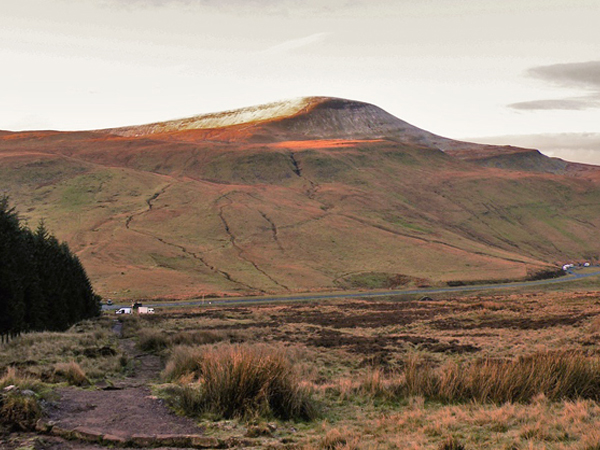
And then, of course, there were the mountains. Pen y Fan started beneath a sky so clear and blue that it almost felt suspicious.
I had expected cold, rain and misery, so naturally the sunshine made me bold. Far too bold, probably. The path climbed through open grassland, past sheep, little streams and one of those valleys so beautiful that you begin trusting the day more than is sensible.
That is usually when the weather starts plotting.
Higher up, the mist crept in, slowly, like a secret. One moment there was a landscape stretching out around me. The next, its edges softened, blurred and vanished. The wind sharpened and the temperature dropped. Then came snow, because Wales clearly felt that mist alone lacked commitment.
A sensible person might have turned back but I was young and badly in need of adventure.
So I kept climbing into the white, bent against the wind, my cheeks burning and my hands cold, while my boots sank into the wet ground. Eventually, I reached the top and was rewarded with one of the most impressive views of my early travelling life.
Nothing.
Absolutely nothing.
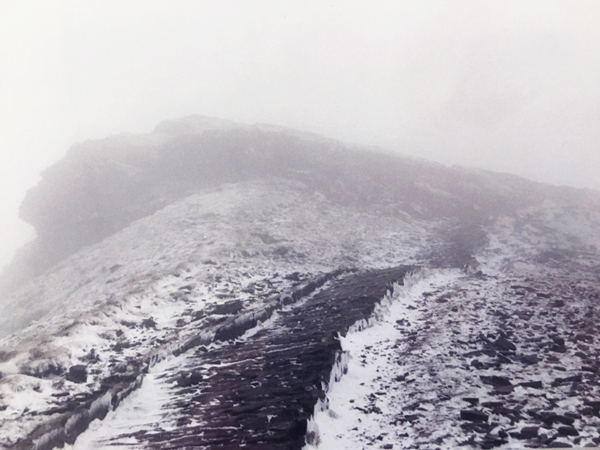
No sweeping mountain panorama. No dramatic valley below. No triumphant postcard moment. I stared at a glowing wall of grey and the strange satisfaction of having reached a summit that refused to reveal itself. I should have been disappointed. Instead, I added the experience to what would become one of my most reliable travel collections: mist views. Some people collect magnets. I collect landscapes I technically climbed but could not see.
A month later, still determined to end my time in Birmingham with beauty rather than urban exhaustion, I headed back to Wales.
A three hour bus ride brought me to Machynlleth, and from there I boarded a small local bus towards Corris. By then, it was already dusk. Not romantic golden hour dusk, but the darker, colder kind of winter dusk in which the world appears to fold in on itself.
I was the only passenger. This is the kind of detail that sounds charming in daylight and deeply questionable after dark.
The bus pulled away, and soon the little rivers, green hills and villages disappeared into the mist and into blackness. There were no familiar landmarks, no comforting sense of where I was and no cheerful signs saying, “Almost there, traveller. Do not worry. This is still Wales and not the beginning of your disappearance.”
There was only the beam of the headlights slicing through the darkness.
The road twisted on.
And on.
And on.
I remember sitting there strangely calm, which was perhaps the most alarming part of all. Some distant corner of my brain did point out that I was alone on a small bus, heading into the middle of nowhere, in a country where I still could not pronounce half the place names even when they were written down slowly but the rest of me remained perfectly relaxed. Apparently, my survival instincts had decided to take the evening off.
Eventually, the bus dropped me in Corris, and I walked up a steep hill towards the youth hostel. The place was quiet and beautiful in that remote winter way, where every sound seems louder because there are so few of them. Then I discovered that I was the only guest for the night.
Excellent. Perfectly normal. Not at all the kind of situation that makes you mentally review every horror film you have ever watched.
The owners were lovely, which helped enormously. Instead of locking me in a cellar or revealing themselves as members of an ancient Welsh cult, they invited me to join them at a meditation evening with friends in Aberllefeni, inside an old chapel that was being transformed into a meditation centre. Apparently, when you travel alone through Wales, you can begin the evening in a creepy bus to nowhere scenario and end it sitting inside an old chapel, meditating and discussing life deep into the night with complete strangers.
The next morning, the world had softened again. Wales, which had seemed so dark and secretive the night before, unfolded into hills, small rivers, sheep, old stone, pale winter light and that unmistakable feeling that stories had lived in the landscape long before you arrived. From there, roads and railway lines carried me farther north, past scenic train routes, coastlines and castles, until I eventually reached Snowdon.
By then, I really should have understood the Welsh mountain system. A clear sky at the bottom means nothing. Optimism is not equipment. Mist is not a mood, but a local character who enjoys following hikers uphill. Still, Snowdon began beautifully enough to trick me.
Again.
The sky was blue, the air was crisp and the path looked perfectly inviting. I set off with Liam, a South African Irish traveller I had met along the way, and for the first part of the climb everything felt wonderfully straightforward.
“This isn’t too bad,” I said, looking up towards the mountain.
Liam glanced at me. “You know saying that out loud is usually how these things begin.”
“What things?”
“Rescue operations.”
I laughed. The sun was still shining, the trail was clear and there were other walkers around us. It seemed absurdly dramatic.
Then Wales did what it always does.
Higher up, the mist returned like an old friend with serious boundary issues. It rolled over the mountain and swallowed the landscape behind us. The air grew colder, snow began falling and the path became steeper, rougher and considerably less path like.
Liam stopped and stared at the rocks ahead.
“Is this still the walking route?”
“I think so.”
“You think so?”
“There are footprints.”
“There are also footprints near cliffs.”
“That is not helpful.”
Neither was the fact that the footprints soon appeared to scatter in several directions, as though previous walkers had arrived at the same point, panicked and each chosen their own personal route towards disaster.
We climbed farther. The wind picked up and snow began collecting on our jackets. At one particularly steep section, a group of walkers coming down paused to look at us.
“You’ve got climbing gear?” one of them asked.
Liam and I looked at each other.
“We have boots,” I replied.
The walker frowned. “This is one of the harder routes. It gets quite technical higher up.”
There was a brief silence.
“Isn’t there just a walking path to the top?” I asked.
“There is,” he said. “On the other side.”
We watched them disappear into the mist.
Liam turned towards me. “So, in technical mountaineering terms, we have gone a little bit wrong.”
“Only a little.”
“How little?”
I looked at the steep wall of snowy rock ahead.
“Let’s not ruin the adventure with measurements.”
We should probably have turned back. In fact, there were several moments when turning back would have been the sensible, mature and entirely reasonable thing to do. Unfortunately, we had already climbed far enough for the summit to stop feeling like a place and start feeling like a personal argument. We pushed on.
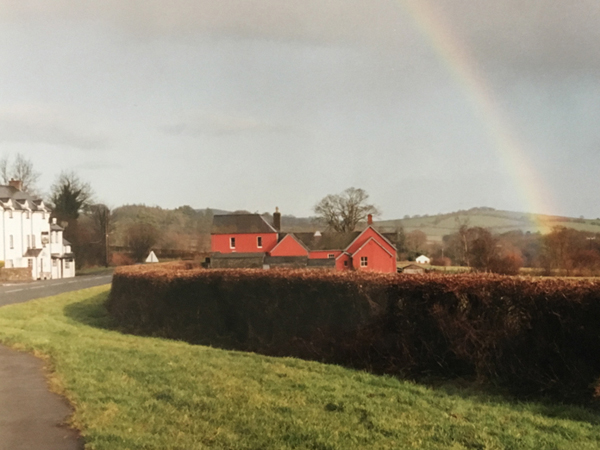
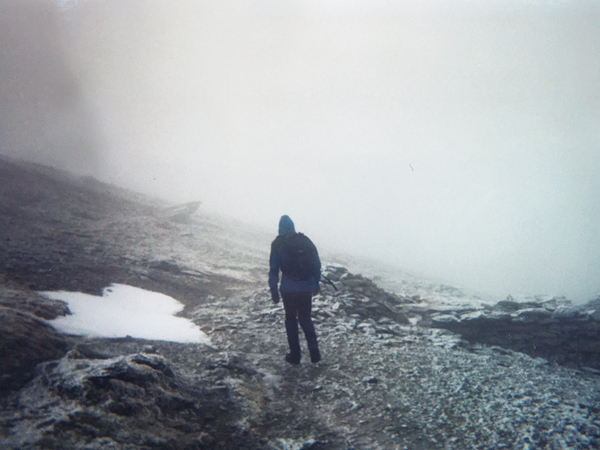
The climb became a world of snow, stone, breath and mist. Our feet were cold, our fingers numb and every few minutes we stopped to catch our breath while pretending we were merely admiring the view.
“There is no view,” Liam pointed out during one of these pauses.
“I’m admiring the mist.”
“We saw the same mist ten metres lower.”
“This part has more depth.”
At another steep section, I pulled myself up over a rock and waited while Liam followed.
“Still enjoying the adventure?” he asked.
At another steep section, I hauled myself over a rock and waited while Liam followed, both of us breathing hard and slowly losing all feeling in our fingers.
“Still enjoying the adventure?” he asked.
“Absolutely,” I said through chattering teeth, summoning what remained of my enthusiasm. “I’m having a wonderful time. I may also be dying, but the spirit is still strong.”
Eventually, figures began to emerge from the whiteness ahead of us. For one hopeful second, I thought we had encountered another group of lost hikers. Then the summit marker appeared.
We had made it!
The summit of Snowdon. The highest point in Wales. The grand reward.
The view? A white wall and five other equally foolish hikers standing inside the same frozen cloud.
Liam stared out into the mist.
“Beautiful,” he said.
“Spectacular.”
“I can almost see the entire country.”
“I think that grey patch might be England.”
He nodded solemnly. “Definitely England.”
I would love to say the moment was majestic. I am sure the landscape was magnificent somewhere behind the weather. But the mountain gave nothing away except the knowledge that we had reached the top, and in that moment, that was enough.
That was Wales for me. I went looking for peace and found it on misty mountain tops, in landscapes that kept their views hidden and, unexpectedly, inside an old chapel after a lonely and slightly creepy bus ride into the darkness.
And somehow, that was even better.