
Wild flippers and a crash landing
After Australia, New Zealand felt different, safe and polite.
After weeks of crocodile warnings, box jellyfish, overheating in the Red Centre, lizards that looked like tiny dragons and a Great Barrier Reef dive where my own laughter nearly turned into a very stupid obituary, New Zealand seemed softer at first glance, greener, cooler and more civilised. The land of misty mountains, sheep-dotted hills, tidy campsites and weather that felt suspiciously Belgian seemed a bit too polite after wild Australia.
Which, in hindsight, was clearly premature.
New Zealand may not shout its wildness in the same hot, red, venomous way Australia does, but it has its own quiet talent for reminding you that nature is not a theme park, wildlife is not waiting to pose for you, and flying is only romantic until gravity gets involved.
The first reminder came with flippers.
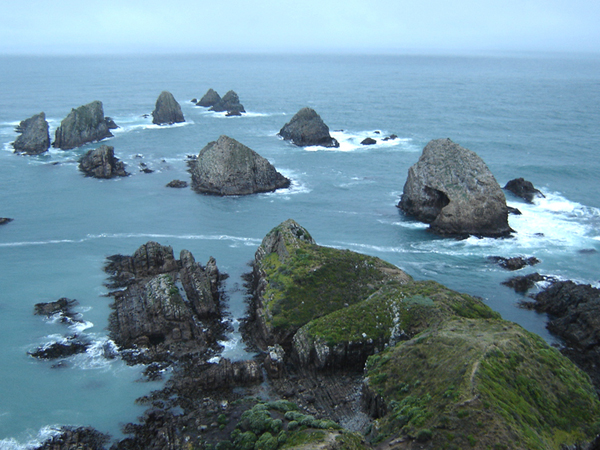
We were exploring the wild coastline near Nugget Point, one of those places where the land seems to fall dramatically into the sea just to prove a point. Jagged rocks were scattered across the water like a giant had emptied his pockets, waves were booming below the cliffs, seabirds were screaming into the wind, and seals and sea lions lay sprawled over the rocks like overfed beach bums after a long lunch.
It was raw, noisy, dramatic and full of life. Naturally, I was enchanted. Also naturally, I had my camera ready.
At some point, we took a little detour down to the beach, just to stretch our legs and get closer to the wildness, because apparently I have always struggled with the concept of admiring things from a perfectly safe distance.
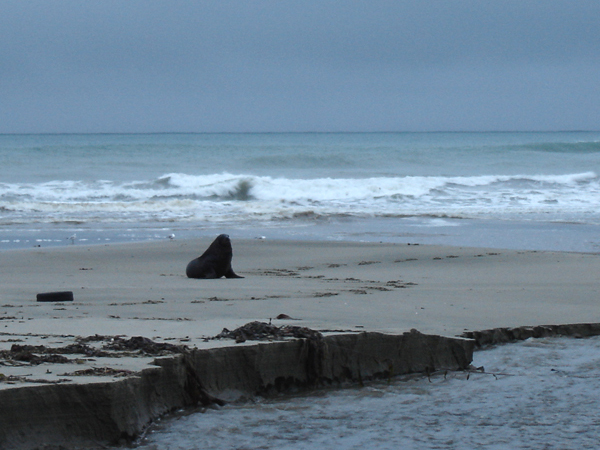
That was when we saw him. A massive sea lion, stretched out on the sand with the lazy authority of an animal who clearly owned the entire beach and possibly several surrounding islands.
He looked peaceful and sleepy. He looked, to my foolish European eyes, like something that might make a fantastic short video.
So I started filming.
At first, he moved slowly. Just a little shift of the head, a push of the body, a heavy shuffle forward.
“Aw,” I said, still looking through the camera. “He’s walking.”
From the camper, Tom shouted something. I registered it vaguely as a warning, but I was far too absorbed in my masterpiece of wildlife cinematography. The sea lion was moving, I was filming, the wind was dramatic, the scene was perfect.
Then I looked up from the lens. The sea lion was no longer “walking”. He was charging!
Not gracefully, obviously, because sea lions are not built for elegance on land, but that somehow made it worse. He was power-lumbering towards me like a furious sofa with teeth, moving far faster than any animal shaped like that has the right to move.
For one frozen second, my brain refused to understand the situation. Then it understood everything at once.
“Oh sh—!”
I ran.
It was not a dignified run, but a full-body panic scramble with flailing arms, kicking sand and a sudden deep respect for mating-season boundaries. Behind me, the sea lion stopped near the road, reared up and roared in a deep, furious, primal sound that seemed to vibrate straight through my ribs.
In my head, he was absolutely shouting, “Yes, human, that is what I thought. Keep running.”
I reached the camper breathless, wide-eyed and very aware that my career as a fearless wildlife filmmaker had lasted approximately thirty seconds.
Tom gave me that look. The one that says: you are really on a mission to get yourself killed here? What were you thinking?
And honestly, fair. Because sea lions may look like sleepy blobs of marine sausage when they are resting on a beach, but they are still wild animals with territory, instincts and sprint mode. I had been too close. Too focused. Too eager for the shot.
Lesson learned. Admire the wildlife. Respect the wildlife. Do not let the zoom lens convince you that you are invisible.
You would think this might have satisfied my quota for adrenaline. It did not.
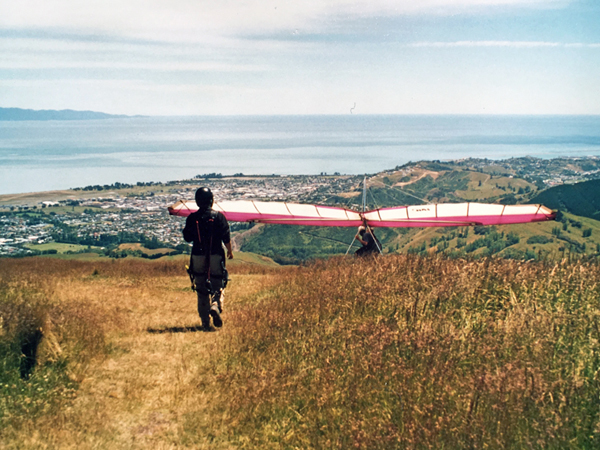
Somewhere between the glacier hikes, penguin sightings, sea lion drama and the growing list of moments where Tom’s blood pressure had been tested on my behalf, I saw a flyer for paragliding or as my brain translated it: yes, please, let us attach ourselves to some fabric and run off a hill.
The first attempt in Queenstown had been cancelled because of rain, which I accepted with all the grace of a disappointed child denied dessert. But now there was another chance. The sky was clear, the mountains were glowing, and the part of my personality that enjoys questionable ideas had fully woken up. There was just one minor issue.
The instructors preferred afternoon flights, when the thermals were stronger, but by then we had to be on the road again.
A sensible person would have said, “Ah well, next time.”
I asked, “Could we maybe try earlier?”
The woman at the desk checked the weather, looked at the time, and said they might be able to try at eleven if conditions held.
That was enough for me.
We rushed to the drop zone, where Tom would wait to watch my elegant landing, probably already preparing to take a nice photo of me floating gently back to earth like a relaxed alpine bird. That was the plan.
Plans, as we know, are mostly suggestions life enjoys editing.
At the top of the hill, the sky looked flawless, a crisp blue canvas behind snow-dusted peaks. The view was ridiculous in the best possible way. The wind however was not ideal. The morning thermals were weak, and the instructor hesitated.
I, naturally, pleaded. “Let’s just give it a try. Please?”
He gave the sigh of a man who knew better but had just met enthusiasm in hiking boots, and agreed.
The instructions were simple enough.
Run.
Keep running.
Do not sit down too early.
My feet hit the ground, then suddenly they did not.
The earth dropped away beneath me and I was flying.
For a while, everything was perfect. Below me, the landscape opened in greens and golds. Above me, hawks circled in the clear air. The wind held us, lifted us, carried us, and for a few glorious minutes I understood why humans keep inventing ridiculous ways to leave the ground.
It was freedom. Pure, floating, wide-open freedom.
Then the thermals kicked in. We climbed higher, spinning in slow circles, the world tilting beneath us. I was thrilled, dizzy, weightless and completely in love with the sky.
Then my instructor said, far too casually, “Small change in landing.”
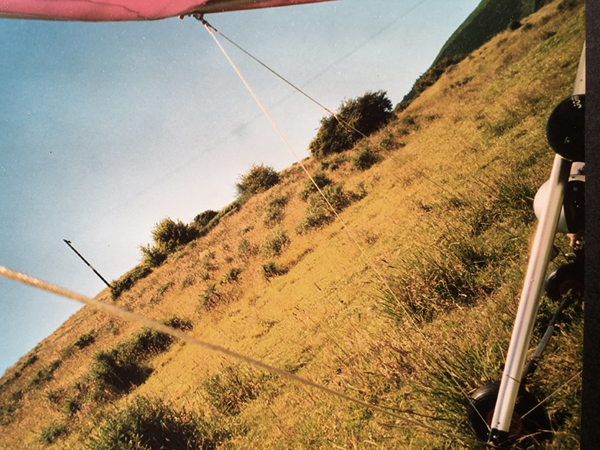
A phrase like that should always be treated with suspicion. It turned out we would not be landing where Tom was waiting. The wind had changed its mind. I trusted the instructor. He seemed calm, experienced and very much not the sort of person who wanted to crash before lunch. Still, I was not prepared for what happened next.
We dived.
Not gently.
Fast.
The ground rushed up at us with alarming enthusiasm. Trees appeared. Bushes appeared. My thoughts briefly left.
Then we hit.
Hard.
We landed and skidded across the ground like someone had thrown a picnic blanket into a storm. Brambles flashed past, straps tugged, fabric collapsed and my right shoulder took the kind of impact that makes your body file an immediate complaint.
For a second, I lay there trying to decide whether I was injured, alive or simply very surprised.
“You okay?” the instructor asked, already unhooking the harness.
I blinked.
“I think so.”
He winced. “Sorry about the crash landing. That’s… not standard.”
Comforting.
By the time we made our way back to the original landing zone, Tom looked as if he had aged ten years.
“They said you crashed!” he shouted.
“Technically,” I said, brushing myself off, “we did.”
He stared at me.
And this, I believe, was the moment when he mentally reviewed the trip so far: the Great Barrier Reef regulator incident, the sea lion chase, and now a paragliding crash that was apparently not part of the standard package.
“That’s the third time this trip you dodged a bullet,” he said.
I raised one hand solemnly.
“I promise. No more death-defying stunts for the rest of the trip.”
He narrowed his eyes.
“We still have a few days left.”
Fair point.
Because the truth was, New Zealand had not been as soft as I first thought. It had simply been quieter about its wildness.
Australia had warned me with heat, crocodiles and giant warning signs. New Zealand waited until I was relaxed, then sent a territorial sea lion and a questionable landing pattern to make sure I was still paying attention.
And I was.
Very much.
By then I had learned that wild places do not always come dressed in red dust and danger signs. Sometimes they wear mist, green hills and postcard views. Sometimes they roar at you from a beach. Sometimes they lift you gently into the sky, then return you to earth with far less grace than expected.
But they always leave you with a story.
And, if you are lucky, only a badly bruised shoulder and a slightly traumatised travel partner.